
If you heard on the news that heavy flooding had caused five deaths in Shimen County, Hunan Province, in central China, you probably wouldn’t feel much.
Sure, it’s sad. But it probably wouldn’t make you feel sad.
And if I asked you about the flooding story later the same day, you probably wouldn’t remember any of the details.
That’s what happens when we process information. We don’t respond emotionally to information, and we don’t remember it either.
But if I told you the story of just one of those five people, your response would be very different.
A grandfather, after making sure his entire family was safe upstairs, out of reach of the floodwaters, noticed the family dog struggling in the flooded street below. He rushed out to save it – and that was the last time his family saw him.
Now you feel something, because it’s a story. It’s the story about a grandfather who rushed out to save the family dog, and died as a result. We relate, we empathize, and we feel an emotional response deep inside our bodies when we hear that story.
If you ask me if I remember that story at the end of that same day, I absolutely will. I may remember that story for weeks, months, or even years.
In the world of marketing the same rules apply.
If you describe something to me, I will feel nothing and I’ll forget what you told me.
If you engage me with a story, I will feel something and I will remember the story you shared.
Now let’s tie that into marketing specialty coffees.
If I visit ten different specialty coffee websites, I can almost guarantee that I will come across one or more of the following phrases.
“From seed to cup”
“Ethically sourced”
“Small-batch roasted”
“Direct trade”
“Craft coffee”
“Single origin”
These are generic descriptions and statements. When I read them, I may recognize them from other places, from other websites, but they won’t make me feel anything. They certainly won’t differentiate your coffee business.
But if you tell me a story…
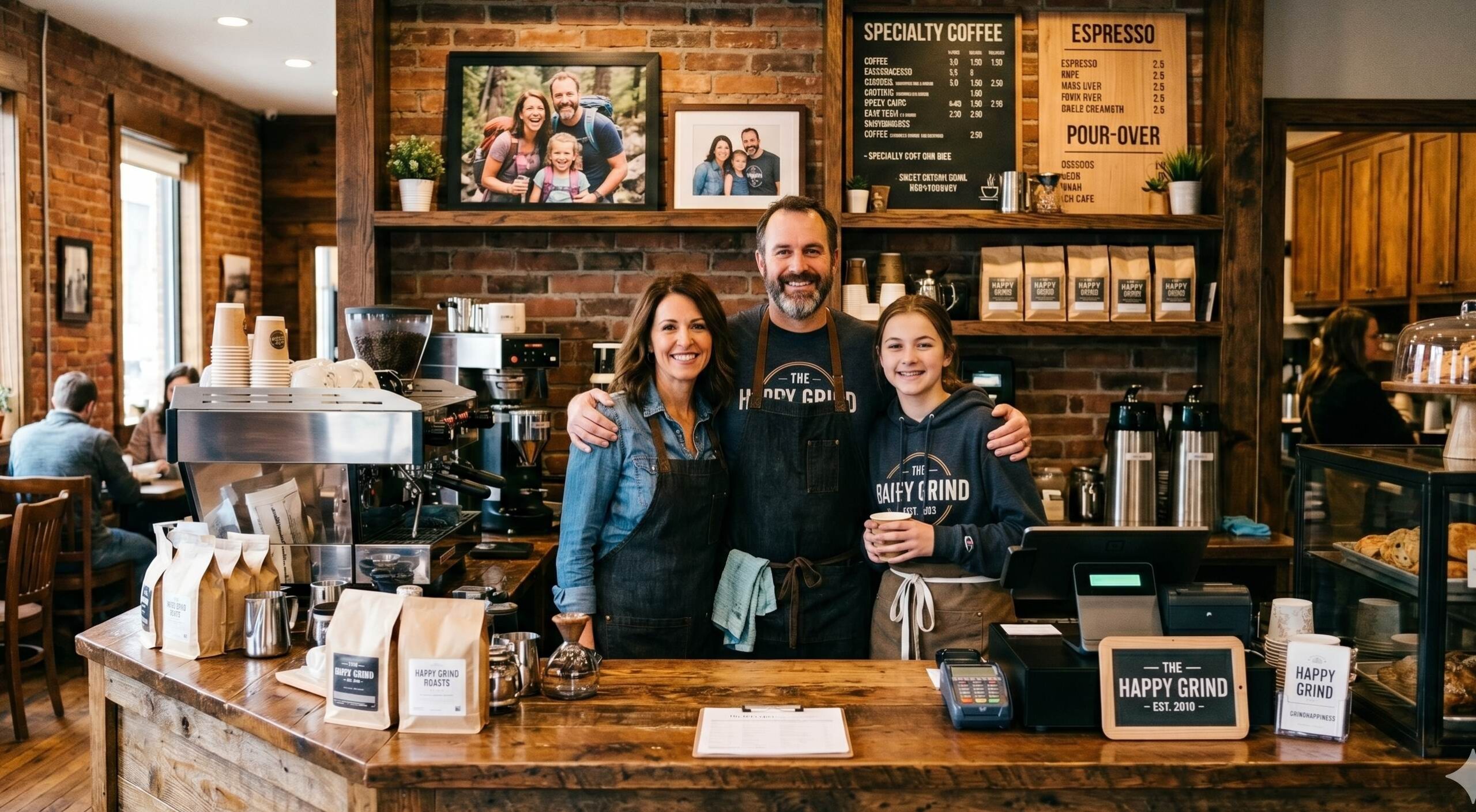
If you tell me that you have a coffee shop in your local neighborhood because you’re following a family tradition, that might catch my attention. When you go on to tell me that your father and his father before him had small grocery stores on this same street, now I’m more deeply engaged.
With that story shared, I no longer look at your coffee shop as being the same as any other coffee shop. It’s something different entirely: it’s the continuation of a long family tradition that stretches back many decades.
If I live in the same neighborhood, your coffee shop now becomes very special to me, as a historical anchor for the entire community. When I come and order a coffee in your shop, I feel part of something. Something that has deep roots.
Of course, not every coffee shop or roastery has that kind of community story. But they all have a unique origin story or founder story. And you can leverage that story to move your messaging beyond a flat description to a conversation that makes people feel and care.
As any professional marketer or copywriter will tell you, people don’t buy because of what you tell them.
They buy because of how you make them feel.
And for specialty coffee companies, the fastest route to getting people to feel something is to share your story.
NOTE: If you’re a specialty coffee roaster, and would like me to run a free Language Audit on your website, get started here.