
Coffee is a commodity. A coffee bean is a coffee bean and, by and large, all coffee beans look the same.
The journey coffee beans take from the tree through processing, distribution, roasting, and delivery to your doorstep… is also the same.
This presents coffee roasters and stores with a problem. How can they differentiate their coffee brand from everyone else’s?
How other industries handle this.
Coke and Pepsi are almost the same product. Conduct some blind taste tests and most people can’t identify which is which. They create the points of difference through distinct marketing approaches. Coke differentiates itself as the more classic, family-oriented, and nostalgic brand. Pepsi positions itself as youthful, energetic, and a bit rebellious.
Apple follows a similar playbook when setting itself up as an alternative to Windows. Apple computers are for the misfits, and for the people who “Think Different”.
Both companies understood something important: when the product itself can’t do the differentiating, the heavy lifting has to be done with story.
Meanwhile in the world of coffee…
You would think specialty coffee brands would work hard to set themselves apart from the competition. A few outliers — Death Wish Coffee, Bulletproof — have done exactly that. But across the mainstream specialty market, something different is happening.
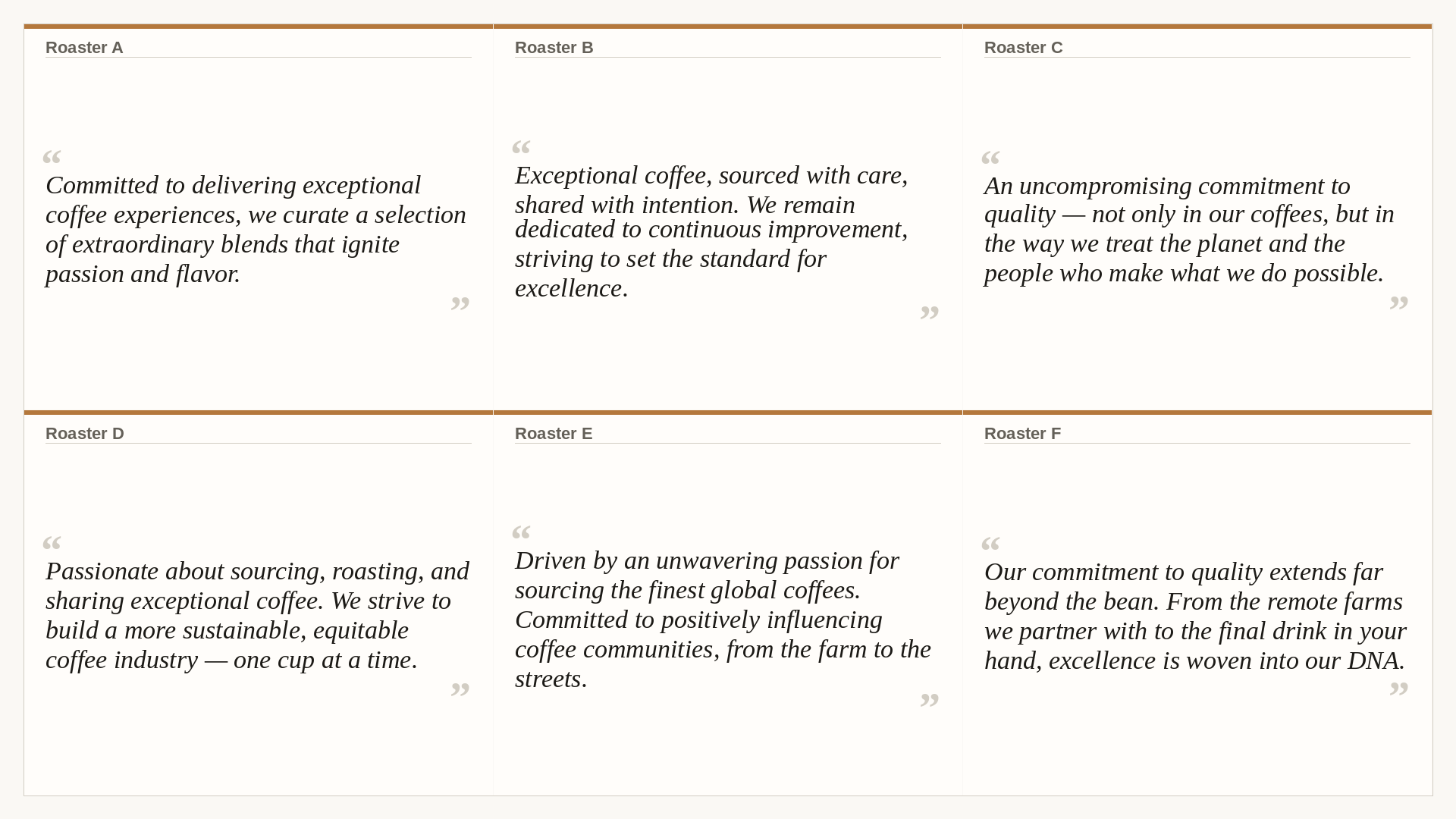
In the image above you can see six statements drawn verbatim from six different specialty coffee websites. (I didn’t have to look hard to find them.)
Every one of these brands is genuinely trying to communicate its value. The problem is that they’re making the same claims, using the same vocabulary. And a vocabulary shared by everyone belongs to no one.
This is the paradox. The brands most in need of differentiation are falling into a sameness trap.
If you want coffee drinkers to choose your coffees, and come back and sign up for your subscription service, you can’t follow the same path as everyone else.
Forget the claims and descriptions. Focus on your stories.
Every independent coffee business has more story material than it realizes. The question is whether it’s being used.
- Your origin story — why this, why then, why you
- Your founder story — the specific path that led here
- Your employee stories — the people behind the product
- Your customer stories — the relationships you’ve built
- Your struggle stories — the hard parts, honestly shared
The power of genuine story goes beyond differentiation. Stories are sticky. People remember them. Stories find a place in people’s hearts in a way that a positioning statement never will. They create the kind of emotional connection that turns a one-time buyer into a subscriber, and a subscriber into someone who tells their friends.
Stories will always outperform statements like: “Exceptional coffee, sourced with care, shared with intention.”
While your competitors are busy sharing with intention — whatever that means — you could be telling a story that only you can tell.
If you’d like to see how widespread this pattern is across the specialty coffee market, The Sameness Report documents it across 50 coffee websites. It’s a free download.
And if you’re a specialty coffee roaster, and would like me to run a custom language audit on your website, get started here.